

How Often Should Woodstove Chimney Be Cleaned
Every editorial product is independently selected, though we may be compensated or receive an affiliate commission if you lot buy something through our links. Ratings and prices are authentic and items are in stock as of fourth dimension of publication.
How oftentimes to remove creosote to prevent chimney fires and do a fireplace cleaning.
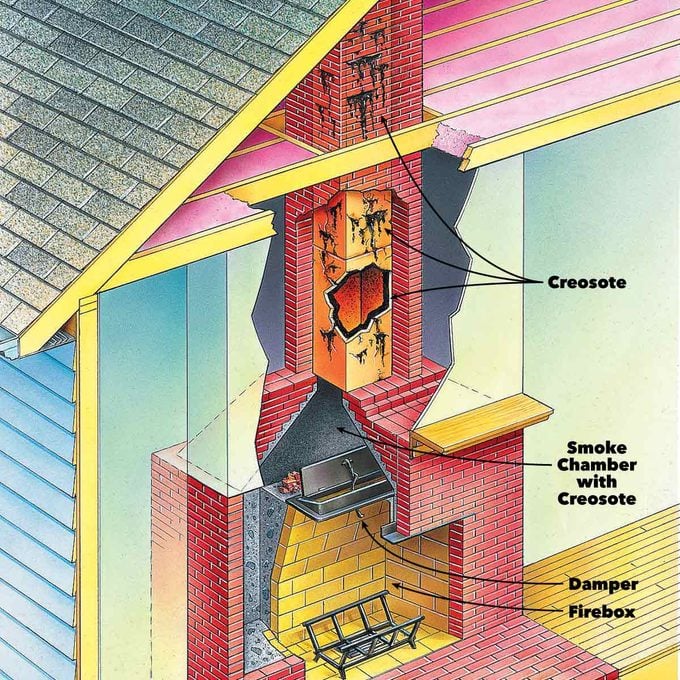
How Often Should You Clean Your Chimney?
At that place isn't a elementary dominion of thumb on how ofttimes to clean your chimney, such as cleaning after 50 uses or one year. But it's still an important task, every bit a smoky burn without plenty oxygen emits lots of unburned tar vapors chosen "creosote" that can condense inside the fireplace flue and stick to it, possibly leading to a chimney fire. You lot tin reduce creosote buildup in your fireplace flue past providing adequate combustion air, which volition encourage a hot, clean-burning fire.
How to Bank check for Creosote
To check for creosote yourself, first, brand sure there's no downdraft from the chimney. If y'all experience an airflow, open a door or window on the same flooring as the fireplace until the downdraft stops or reverses and air flows upwards (tape tissue to the fireplace opening and sentinel its movement). So, while wearing goggles and a basic disposable dust mask, take a stiff flashlight and your fireplace poker and scratch the black surface above the damper (fume bedchamber).
If the groove y'all scratch in the creosote is paper thin, no cleaning is needed. If it's 1/viii in. thick, schedule a fireplace cleaning soon. If you lot have 1/4 in. of creosote, do non employ the fireplace again until it is cleaned—a chimney fire could occur at any fourth dimension.
The easiest creosote to remove is the feather-light boring gray, brown or black soot. The side by side form is a black granular accumulation, removed fairly easily with a stiff chimney brush. The third type of creosote is a road tar-like coating that is much harder to remove fifty-fifty with stiff chimney brushes, scrapers or power rotary whips. The concluding (and virtually deadly) is a shiny, glaze-like coating on the fireplace flue that is virtually impossible to remove.
Required Tools for Cleaning a Chimney
Have the necessary tools for this chimney cleaning DIY projection lined up before you start—you'll relieve time and frustration.
- Dust mask
- Flashlight
- Prophylactic spectacles
How to Remove Creosote
You could try to remove creosote yourself, only for a thorough task, phone call a chimney sweep who'south certified past the Chimney Rubber Institute of America. Make sure the sweep you hire does more than pushing a brush. A chimney sweep needs to be knowledgeable about edifice codes, trained to recognize deterioration or venting issues and able to advise you regarding the chimney's condition. The National Burn Protection Association recommends that chimneys, fireplaces and vents be inspected at to the lowest degree once per twelvemonth.
Some other, idea to try out when it's time to clean your chimney is a chimney sweep log. A fireplace cleaning log helps to prevent chimney fires and they help remove debris deposited along the chimney walls. These gluey deposits are called creosote. Creosote deposited over a long period becomes highly flammable and information technology's often the crusade of chimney fires. Creosote removal is vital to your safety. Sweeping logs are popular because of their ease of use for creosote removal. All you lot have to do is unwrap the log from its packet and place it in a lit wood burning fireplace.
Chimney Cleaning Cost Tip
Save money and avoid a long look by having a chimney inspection and fireplace cleaning in the spring.

Source: https://www.familyhandyman.com/article/when-to-clean-a-chimney-flue/
Posted by: boyerfrous1999.blogspot.com
0 Response to "How Often Should Woodstove Chimney Be Cleaned"
Post a Comment